
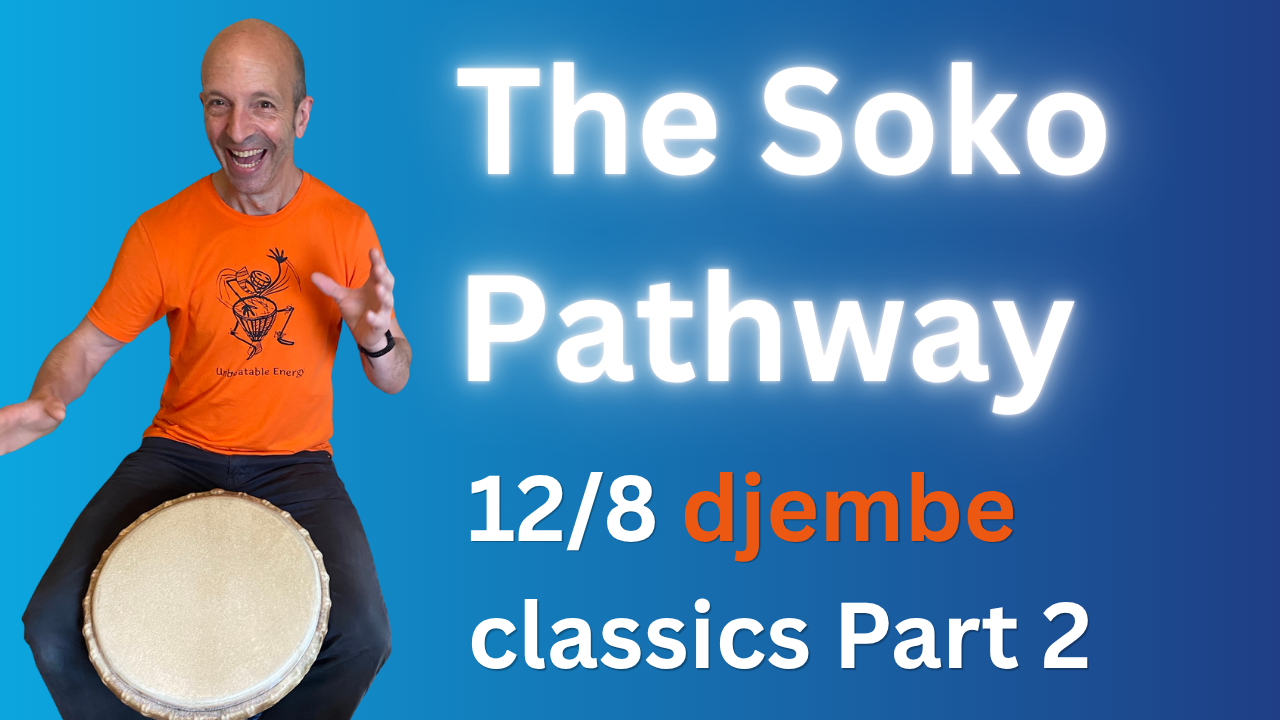
The Soko Pathway: A Step-by-Step Journey Through the 12/8 Djembe Feel (Part 2)
A few months ago we shared Part 1 of this series — a 10-week journey through what I called the Soli Pathway, exploring one particular style of 12/8 feel found in West African djembe playing.
This blog continues that journey with Part 2, shifting into the Soko-style pathway — another important branch of the ternary world with its own distinct movement, swing and rhythmic personality.
If you’re enjoying my drumming tutorials and want to support future videos, you can buy me a coffee. Every contribution helps keep the rhythm going!
While the Soli Pathway often leans around the pulse with a flowing before-the-beat feel, the Soko-style approach explores a different kind of tension and release. As the series develops, you’ll hear how the same ternary foundation can produce a completely different musical sensation depending on where the phrases sit against the pulse.
As with Part 1, these videos build gradually. Each lesson introduces a new rhythmic idea while connecting back to the underlying feel that runs through the whole pathway.
Whether you’re completely new to ternary djembe or already familiar with 12/8 accompaniment playing, the aim here is not simply to memorise patterns, but to develop a deeper understanding of flow, placement and musical feel.
So grab a drum (or even a table!) and enjoy the journey through the Soko pathway.
WEEK 1 — The Call Tells You Everything
Part 2 begins by focusing on a classic Soko-style call — a short phrase that already contains many of the characteristics of the Soko feel.
Rather than treating the call as just a signal to begin the rhythm, this video explores how its shape, movement and phrasing reveal the underlying direction of the groove itself. Even within this small musical idea, you can already start to hear the distinct personality of the Soko pathway.
If you want to understand these rhythms more deeply — not just memorise patterns — this is a strong place to begin.
WEEK 2 — Fire, Feel & Échauffement
This video takes the first practical steps into the Soko feel through a simple échauffement — a flowing warm-up pattern closely connected to village music, dance and movement.
Rather than focusing on learning a full rhythm, the aim here is to begin feeling the character of the Soko pathway itself. By using a repetitive échauffement, we can explore different shades of the Soko feel within the 12/8 cycle without the distraction of complex repertoire.
In many African ballet contexts, échauffements are woven directly into performance, with drummers and dancers warming, moving and playing together. Here, the échauffement becomes more than a technical exercise — it becomes a doorway into the feel itself.
Think of this episode as lighting the fire before the form.
Beginners can focus on coordination; more experienced players can listen for the subtle movements inside the groove.
WEEK 3 — Soko Pathway Foundations
This lesson begins with one of the most universal accompaniment patterns in 12/8 djembe playing — a simple groove that defines the pulse and sits underneath countless ternary rhythms. It’s an approachable starting point for beginners and a useful grounding exercise for more experienced players wanting to strengthen their internal sense of time.
From there, the video introduces a second pattern that points more directly towards the character of the Soko rhythm itself. Although closely related to the first groove, subtle changes in placement and movement begin to reveal the distinctive feel of the Soko pathway.
Later in the session, we explore the use of ghost notes and very subtle swing, shifting the focus away from the notes themselves and towards the underlying feel of the groove. Even small changes in placement can completely alter the character of the rhythm.
WEEK 4 — Tiriba Pattern
This lesson focuses on the classic Tiriba accompaniment pattern and the distinctive way it fits around the pulse within the Soko pathway.
The groove is introduced in two stages: first through a simplified coordination to help establish the movement, followed by a more traditional handling of the rhythm itself.
The aim is not simply to memorise the pattern, but to clearly hear and feel the accented beat-after-the-pulse quality that gives Tiriba its particular character and drive.
WEEK 5 — Simple but Deceptive
This lesson explores a Soko-style 12/8 djembe pattern that sounds quite straightforward at first, but becomes surprisingly deceptive once you settle into the pulse.
The hand movement itself is relatively simple, yet the ear often wants to pull the phrase into a completely different place. In the video we slow things down, unpack where the accent actually sits, and explore why this kind of placement can feel both confusing and deeply satisfying once it finally locks in.
It’s a great example of how subtle placement within the pulse can completely transform the character of a groove.
WEEK 6 — Soko Bass Patterns
This lesson introduces two core djembe bass patterns that sit underneath many Soko-style 12/8 rhythms — an accessible version followed by a slightly more advanced variation.
These grooves form part of the foundation of the Soko pathway, providing the weight, momentum and stability that many of the other phrases build upon.
The video also touches on an interesting aspect of the coordination within these patterns. They’re presented as traditionally taught, but there’s something worth noticing in the way the hands move and organise themselves around the pulse.
After the more deceptive phrasing explored in the previous lesson, this session returns to weight, clarity and grounding — sitting deeply inside the groove and allowing the drum to speak.
WEEK 7 — The Djembe Rhythm That Tricks Your Brain (Dembadon Pattern)
This lesson explores a deceptively simple djembe pattern from Dembadon that many players instinctively pull into the wrong place once the pulse begins.
Although the sticking itself is straightforward, the ear naturally wants to reorganise the phrase into a different groove altogether. It’s a fascinating example of how rhythm perception works — even when we intellectually understand where a pattern should sit, the brain can still hear it differently.
In the video, the pattern is broken down slowly and anchored carefully against the pulse, helping develop a more reliable internal sense of placement within the Soko-style feel.
This version of the rhythm came through a workshop with master drummer Billy Konaté in March 2025.
WEEK 8 — Beautiful Wassolonka Djembe Phrase
This lesson explores a beautiful but quite challenging djembe phrase drawn from Wassolonka (Ngri) — a phrase I first encountered played by Mamady Keïta.
What makes this pattern so distinctive is the interaction between the slaps and tones. The slaps land very clearly, while the tones move around them in a way that creates a flowing, almost rolling movement through the phrase. The result is a groove that feels intricate, fluid and deeply satisfying once the hands begin to settle into it.
You’ll hear variations of this kind of phrasing appearing across many ternary djembe solos and accompaniments, particularly within rhythms connected to the Soko-style family explored throughout this pathway.
In the lesson, the phrase is broken into smaller sections before gradually being rebuilt into the complete movement, helping reveal how the tones and slaps weave around one another.
There’s also a brief guest appearance from my kitten Zelda, who became very curious about the sound of the djembe during filming.
WEEK 9 — Learn Djembe Swing the Bonkers Way
This lesson explores the feel of a Soko-style backloaded swing, but through a slightly unusual and playful approach.
Rather than relying purely on counting or technical explanation, the video experiments with the way certain spoken English phrases can naturally reflect the movement and phrasing of a rhythm. The idea isn’t to force words onto the groove, but to notice how natural speech patterns can sometimes reveal the feel surprisingly well.
Using the échauffement feel developed earlier in the pathway, the lesson applies this approach both to flowing exercises and to a Soko-style djembe call.
Although playful on the surface, the deeper focus remains the same: developing a stronger instinct for placement, swing and feel within the 12/8 cycle.
WEEK 10 — Understanding Soko: How the Dundun Parts Fit Together
This final lesson brings Part 2 of the 12/8 series to a close by focusing on the dundun parts for Soko.
The session explores the Sangba, Kenkeni and Dundunba patterns step by step before moving into the deeper question of what really gives Soko its distinctive feeling — especially how the swing begins to come alive once the different parts are combined together.
From there, the lesson moves into a more exploratory, ballet-style approach, layering combinations of parts to help reveal how these rhythms interact and support one another. The aim isn’t necessarily to memorise every combination, but to develop a deeper appreciation of how the different voices fit together within the groove.
For players wanting a challenge, there are also opportunities to test coordination, stamina and control — particularly once the closed Kenkeni notes begin driving the movement forward.
This video brings the Soko Pathway journey full circle, showing how many of the ideas explored throughout the earlier lessons finally connect together inside the ensemble.
Explore More Lessons on YouTube
I hope you’ve enjoyed working through this 12/8 Classics Part 2 series and exploring the Soko pathway.
There are many more rhythm breakdowns, groove studies, accompaniment lessons, solo ideas and longer-form teaching series available over on the Unbeatable Energy YouTube channel — with hundreds of videos exploring different aspects of djembe and dundun playing.
If you’d like to continue exploring, you can find the channel here:
https://www.youtube.com/@UnbeatableEnergy
New videos are added regularly, covering everything from traditional accompaniment patterns to improvisation, feel, flow and technique.
Support the Channel
If you’ve enjoyed these lessons and would like to support the time that goes into creating free djembe content for the channel, you can support the work here:
https://buymeacoffee.com/unbeatableenergy
Your support genuinely helps keep these long-form lessons, rhythm breakdowns and pathway series coming.
If you’re enjoying my drumming tutorials and want to support future videos, you can buy me a coffee. Every contribution helps keep the rhythm going!
