
Drumathon: Why I'm Doing It (and How You Can Be Part of It)
Drumathon: Why I'm Doing It (and How You Can Be Part of It)
Drumathon is a personal endurance drumming challenge I’m taking on to raise funds for Project 6, a Sheffield-based charity supporting people affected by drug and alcohol addiction.
Drumathon is a four-hour, non-stop African drumming challenge I’m taking on as both a personal endurance test and a community fundraising event. Playing continuously for that length of time is physically demanding and mentally focused — and that challenge is very much the point.
This project is rooted in my own journey. In my twenties, I struggled with drug and alcohol addiction, and African drumming became one of the things that helped me find structure, focus, and a way forward, alongside the support of other people. That’s why Drumathon is raising funds for Project 6, whose work supports people facing those same challenges today.
Drumathon isn’t just about endurance — it’s about rhythm, support, and bringing people together around something positive.
The short video below explains where the idea for Drumathon came from and what the challenge will involve.
Why Drumathon Matters to Me
African drumming has been part of my life for over three decades, but its role has gone far beyond music. During a difficult period in my twenties, when I was struggling with drug and alcohol addiction, rhythm became one of the things that helped me rebuild structure, focus, and a sense of direction — alongside the vital support of other people. I’m now 26 years clean and sober, and that journey continues to shape how and why I work with rhythm today.
Drumathon grows directly out of that experience. African drumming, with its grounding pulse, shared rhythms, and physicality, taught me the value of staying present and connected through challenge rather than stepping away from it. That’s why this project feels so closely aligned with Project 6, whose work centres on support, connection, and practical help for people affected by drug and alcohol addiction — the same combination of things that made a difference in my own life.
At its heart, Drumathon is about recognising that people don’t get through difficult periods on their own — and that rhythm, community, and encouragement can play a powerful role in that process.
A Shared Rhythm: How Drumathon Works on the Day
Drumathon will take place on:
Saturday 28th February 26 13:00-17:00 at
Sharrow Community Forum, The Old Junior School, South View Rd, Sharrow, Sheffield S7 1DB.
While I’ll be taking on the challenge of four hours of continuous African drumming, the event itself is designed as a community drum circle. People are warmly invited to come and join the drumming, play accompaniment rhythms alongside me, and help carry the energy of the four-hour journey.
Throughout the event, we’ll be supporting participants with simple, accessible African rhythms, and everyone is welcome to play for as long or as little as they like. Some people may dip in briefly, others may stay longer — all of it contributes to the shared experience. Drumathon is about collective rhythm, encouragement, and togetherness, using African drumming as a way to bring people together while raising funds for Project 6.
How You Can Support Drumathon
There are a few simple ways you can support Drumathon and help make the event a success.
If you’d like to sponsor the challenge, you can make a donation via the JustGiving page. All funds raised will go to Project 6, supporting their work with people affected by drug and alcohol addiction.
You’re also very welcome to come along on the day, join the drumming for as long or as little as you like, and be part of the shared rhythm and atmosphere. Every person who plays, listens, or brings encouragement helps carry the energy of the four-hour journey.
And finally, sharing Drumathon — with friends, family, colleagues, or on social media — makes a real difference. The more people who know about it, the more support we can generate for the charity and the wider community.
Thank you for being part of it.

The Soli Pathway: A Step-by-Step Journey Through the 12/8 Djembe Feel (Weeks 1–9)
The Soli Pathway: A Step-by-Step Journey Through the 12/8 Djembe Feel (Weeks 1–9)
Over the past months I’ve been developing a structured series to explore one of the most important foundations in West African djembe playing: the 12/8 feel, and the way it shapes flow, timing, and musical vocabulary.
If you’re enjoying my drumming tutorials and want to support future videos, you can buy me a coffee. Every contribution helps keep the rhythm going!
The Soli Pathway – Weeks 1–9
This first series focuses entirely on the Soli Pathway: a grounded, flowing version of the 12/8 feel that influences how phrases land, how the groove moves, and how your hands begin to relax into the music.
A second series will follow later, exploring the other 12/8 pathway.
These videos build one step at a time.
Each week adds a new layer.
Each groove prepares your hands, ears and instincts for what comes next.
This blog brings together Weeks 1–9 of the Soli Pathway in one place so you can follow the series from start to finish.
(Week 10 — The Big One — has its own dedicated blog coming next.)
So grab a drum (or a table!) and enjoy the journey.
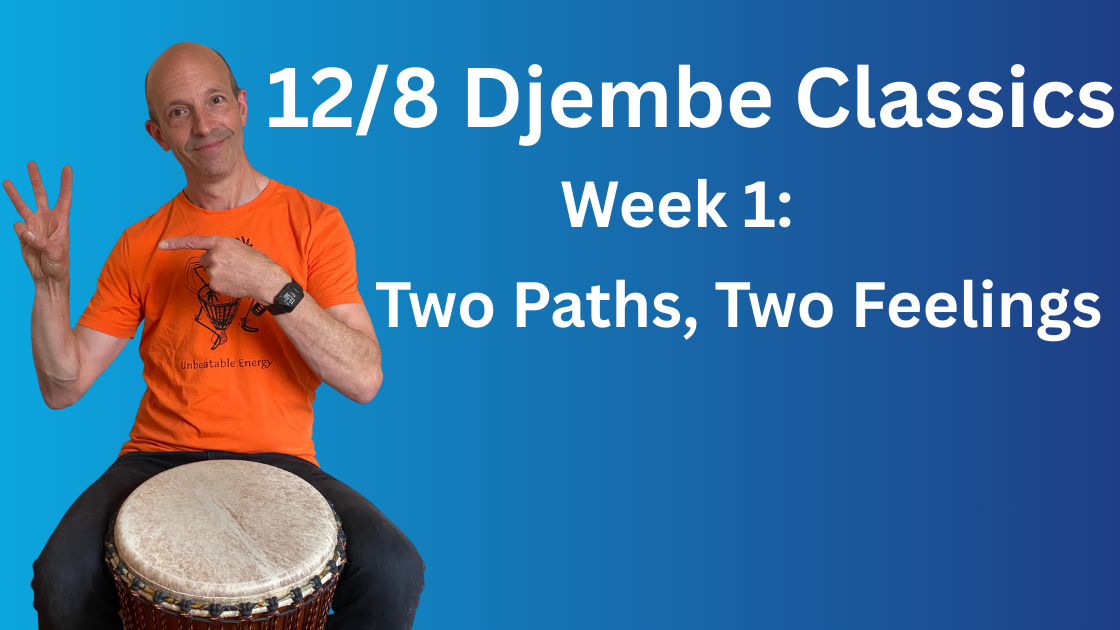
WEEK 1 — Two Paths, Two Feelings
This first lesson sets the whole pathway in motion.
We explore the two different “roads” inside the 12/8 feel — something that’s easy to overlook but completely changes how a rhythm sits in the body.
It’s a gentle start, but it gives you the foundation you’ll use in every video that follows.
→ When you’ve explored these two feelings, you’re ready for the next step.
WEEK 2 — ‘Kanki Ta’ – Essential Groove & Hidden Feel
“Kanki Ta” is one of the simplest ways into the ternary world, but it already carries the character of the Soli Pathway. In this lesson, I explore how the short–medium–long swing shapes the rhythm, and how that internal shift changes its feel.
Beginners can focus on coordination; more experienced players can listen for the subtle movements inside the groove.
WEEK 3 — Feel the Pinch (‘Katikita’ Breakdown)
Here we explore Katikita — a groove with a beautifully “pinched” inner feel created by accents and timing.
This lesson shows how small shifts can give the rhythm shape and character, especially within the Soli Pathway where subtlety matters.
It’s not about adding notes; it’s about adding life.
WEEK 4 — Three Flowing Grooves from Kala
In this video we explore Kala — a joyful rhythm from the Soli family. The lesson looks at three accompaniment patterns that share the distinctive before-the-beat feeling often found in Soli-style grooves.
It’s a flowing set of patterns that helps bridge the earlier material with the more challenging ideas still to come.
WEEK 5 — Garangedon
Garangedon is a traditional rhythm associated with the shoemakers’ caste in Mali, and the version here comes through Mamady Keïta, who brought it into the wider djembe repertoire from Guinea.
What makes it so compelling is the way it captures the Soli Rapide feel — that slight lean before the pulse, creating the suspended, rolling swing that defines so much of this pathway.
In the video we break down the key accompaniment phrase and look at how this subtle shift gives the rhythm its characteristic energy and flow.
WEEK 6 — Joining Up the Djembe Dots
This video picks up directly from Garangedon, exploring a small variation on that groove and tracing how the same before-the-pulse accent appears across other djembe and dundun patterns.
It’s a useful rhythmic touchpoint that shows how the Soli pathway connects so many grooves in the 12/8 family. The aim here is to join up the djembe dots — to hear how this shared feeling flows through melody, rhythm and pulse.
WEEK 7 — Setting the Groove Free
This video takes the Garangedon-inspired ideas from the previous section and begins to loosen them. Up to now we’ve joined the dots between variations; here the focus shifts to avoiding getting stuck in any one version.
Once the classic accent-before-the-beat feeling is in your hands, you can start adding phrases, changing sounds and introducing small spontaneous shifts that move the rhythm toward solo phrasing.
It’s about keeping the same pulse but opening space for expression and play — letting the pattern feel alive rather than fixed.
WEEK 8 — Bass, Flow & Freedom
This video continues directly from the previous section, but now the focus shifts to how bass placement can deepen and open up the groove. Subtle changes in where the bass lands begin to transform the accent-before-pulse feel we explored earlier, creating new levels of flow and freedom.
We’re still inside the 12/8 pocket, but this session takes things further — offering more ways to connect your phrases, ride the groove and begin to improvise with confidence.
WEEK 9 — Liberté Doubles
This video uses the rhythm Liberte as a bridge toward the more complex Soli-style accompaniment that follows. Although not a Soli rhythm, it offers a clear framework for developing the in-between doubles — the quick hand-to-hand notes that sit between the main pulse.
These doubles appear often in Soli-style grooves, so this session focuses on the timing and feel that make that movement easier to control.
What Comes Next? Week 10 — The Big One
Weeks 1–9 form a complete introduction to the Soli Pathway — one side of the 12/8 world.
Week 10 is where everything comes together.
It’s the longest, most detailed lesson in the series and the one that has resonated most with viewers so far. Because of its importance, it has its own dedicated blog post, which will be live shortly.
If you’ve made it this far, you’re more than ready for the final step — keep an eye out, Week 10 is on its way.
Sharing the journey
I’m always exploring new ways to develop solo phrasing and technique — and this roll has been a really enjoyable challenge. Sharing these ideas through video is part of how I keep the learning alive and offer something that others might find useful or inspiring in their own playing.
If you’d like to support the channel and help keep the rhythm flowing, you can buy me a coffee here:
https://buymeacoffee.com/unbeatableenergy
Thanks for reading — and happy drumming!
-Steve Rivers
If you’re enjoying my drumming tutorials and want to support future videos, you can buy me a coffee. Every contribution helps keep the rhythm going!


Remembering Mamady Keïta: Djembe Rhythm ‘Kaloo’ and the Legacy of West African Percussion
Remembering Mamady Keïta: Djembe Rhythm ‘Kaloo’ and the Legacy of West African Percussion
Earlier this month marked the anniversary of Grand Master Mamady Keïta’s passing. In honour of his extraordinary contribution to West African drumming, I’ve shared a new video exploring one of his later compositions — the beautiful rhythm Kaloo.
Mamady is said to have dreamed this rhythm and developed it during his time in San Diego in the early 2000s. I first learnt Kaloo directly from him in 2009, and later revisited it during a workshop in Senegal in 2010 (originally due to be taught by Mamady himself, but led instead by Seckou Keita after Mamady became unwell).
If you’re enjoying my drumming tutorials and want to support future videos, you can buy me a coffee. Every contribution helps keep the rhythm going!
Exploring Kaloo – Djembe, Dunduns & Multitasking
In this new video, I walk through Kaloo’s djembe and dundun parts, slowly unpacking the structure and phrasing. After demonstrating the dunduns, I have a go at one of my favourite challenges: playing and singing at the same time – a playful way to internalise the arrangement and help others feel how the layers fit together.
If you’ve played Kaloo before, I’d love to hear how and where you learnt it. And if it’s new to you, I hope this helps bring you closer to Mamady’s rich and vibrant musical world.
Sharing the journey
I’m always exploring new ways to develop solo phrasing and technique — and this roll has been a really enjoyable challenge. Sharing these ideas through video is part of how I keep the learning alive and offer something that others might find useful or inspiring in their own playing.
If you’d like to support the channel and help keep the rhythm flowing, you can buy me a coffee here:
https://buymeacoffee.com/unbeatableenergy
Thanks for reading — and happy drumming!
-Steve Rivers

Mastering the Flam on Djembe – A Must-Know Technique for Drummers
Mastering the Flam on Djembe ♫ – A Must-Know Technique for Drummers
The flam is a simple yet powerful drumming technique that adds depth, texture, and nuance
to your playing. While often associated with snare drumming, the flam has a unique
application in hand drumming—especially on the djembe.
In my latest video, I demonstrate the flam technique on djembe and how you can use it to develop more fluidity and expression in your playing. If you’ve ever wanted to add more variation and dynamic feel to your drumming, this is a great technique to explore!
What Is a Flam on Djembe?
A flam is typically described as two quick, slightly offset strikes—one as a grace note, followed by a main note. However, on the djembe, the relationship between the two notes is much more fluid.
Unlike snare drum flams, where the grace note is significantly softer, the two notes in a djembe flam can be closer in volume and timing, creating a subtle “double attack” effect. There are many nuances in how wide apart the two notes are, ranging from a very tight, almost simultaneous hit to a more open flam with a pronounced separation.
These subtleties are rarely explored in snare drumming, making the djembe flam a unique and expressive tool in traditional and contemporary rhythms.
Watch the Full Breakdown!
In this video, I present a finished example of the flam technique on djembe and discuss its practical applications. Whether you’re new to flams or refining your approach, this tutorial will give you a clear way to experiment and develop your own variations.
Why Learn the Flam on Djembe?
✔️ Adds texture and dynamics to your playing
✔️ Helps develop coordination and control
✔️ Essential for soloing and improvisation
✔️ Creates subtle rhythmic variations within traditional djembe patterns
What’s Next?
I’m planning more in-depth breakdowns of djembe rolls and flam applications within rhythms—so if you find this video useful, let me know in the comments!
Have you tried incorporating flams into your djembe playing? Drop a comment on YouTube—I’d love to hear your experiences!

Djembe Solo Phrasing – Accenting Every Third Beat
Djembe Solo Phrasing – Accenting Every Third Beat
When it comes to djembe soloing, phrasing and accent placement can make all the difference in creating a dynamic, flowing rhythm. One of the classic techniques that many djembe players explore is accenting every third beat within a ternary feel.
This approach isn’t something new—it’s a well-established phrasing technique in djembe drumming—but it’s one that can really help you develop control, groove, and movement in your solos.
What's In This Lesson?
In this new video, I break the concept down step by step:
✅ Starting with bass and tone placements to feel the phrasing.
✅ Moving to tones and slaps for sharper articulation.
✅ Building a short solo sequence to practice and develop fluency.
Who Is This For?
This lesson is aimed at intermediate players and improvers—those who are already comfortable with slaps and tones but want to refine their solo phrasing.
If you’ve worked with phrasing in threes before, this might be a good chance to solidify the technique and experiment with new variations. And if this is a fresh concept for you, it’s a great way to add a sense of motion and groove to your solos!
Try It Out & Let Me Know!
I’d love to hear your thoughts—do you already use this phrasing approach? How do you incorporate accents into your solos? Feel free to leave a comment on the video or get in touch with me.

'Rubbish Rhythms' Reaches a Milestone: Transforming Music Education
Rubbish Rhythms Reaches a Milestone: Transforming Music Education
Last month, I had the thrilling experience of delivering our new Rubbish Rhythms workshops in four primary schools in Rotherham, marking a significant milestone for this project. This workshop is now fully refined and can be offered to all year groups in Key Stage 1, 2, and 3, making it more versatile and accessible than ever before.


Seeing children engage with the workshop in a way that was both playful and deeply creative was an incredible moment - Watch Here!
The energy in the room, the way their faces lit up when they discovered the rhythms hidden in everyday objects—it reaffirmed everything I set out to achieve with Rubbish Rhythms. This was not just another workshop; it felt like a breakthrough, a true coming of age for the project.
Since 2023, I’ve been on an exciting and unexpected journey with 'Rubbish Rhythms', a project that started as a playful experiment on my YouTube channel and has grown into something much bigger. The original idea was simple: could everyday household objects be transformed into musical instruments? I started my 'Will It Drum?' series, testing everything from cereal boxes to yogurt cartons, exploring the sounds they could make. Watch the series here. 
But what started as a bit of fun quickly turned into something more significant—something with the power to change how people, especially children, see the world around them.
The first real test of the concept came with a teacher training workshop in Aylesbury. This was an opportunity to introduce educators to the idea, demonstrate its potential, and see how it resonated with them. The response was overwhelmingly positive. Teachers saw not just the musical potential but also the creative and environmental value of the workshop. This led me to refine the format further, gearing it towards children in schools, ensuring it was engaging, accessible, and adaptable for different age groups.
https://youtu.be/Zr35TlKJmB0
A trial day with Year 6 students followed, and this was a real turning point. It gave me the chance to see how the workshop worked in practice with a full class, allowing me to make crucial refinements before rolling it out more widely. One of the key lessons was how different materials offered different challenges and opportunities.
Finally, in January 2025 we ran a 4 day project for primary schools at Wickersley Academy Trust in Rotherham and everything came together – with new additions to the mix! Broadband cable tubes, for example, produce fantastic, resonant tones. Water cooler bottles, donated by Eden Springs, are incredibly versatile and function as both hand drums and bass tones. Even the sturdy and crinkly sounds of 'Bags for Life' shopping bags have found their place as percussion instruments, offering an unexpected but effective addition to the ensemble.
Each session has become a journey of discovery, not just for the children but for me as well. What made it even more exciting was that the objects we were playing weren’t just substitutes for normal instruments—they had their own unique qualities, producing funky, rich sounds that stood apart from traditional percussion.

The workshop wasn’t just about making do with alternative materials; it was about celebrating their distinct musical voices. One of the biggest joys of the project has been watching children shift their perspectives on what an instrument can be. Seeing their excitement as they create rhythms from objects they might otherwise throw away has been incredibly rewarding. It’s not just about music; it’s about mindset—challenging the idea that something is ‘rubbish’ just because it’s no longer needed for its original purpose.
Using everyday objects as musical instruments is nothing new—many of the instruments we know today originated from repurposed materials. In the Malinke culture of West Africa, the large wooden mortar and pestle—called ‘Kolan’—is often used as a percussive instrument. In fact, the African Djembe drum itself is believed to have evolved from a refashioned Kolan, taking on a new form as a dedicated musical instrument over time. This connection between everyday activities and music is something I find deeply inspiring.
Beyond the musical aspect, I’ve also been reflecting on the broader themes that Rubbish Rhythms touches upon. While it’s not a recycling workshop in the traditional sense, it does encourage a more thoughtful approach to materials and waste. It invites children to appreciate objects for their potential beyond their intended use, fostering creativity and resourcefulness—two qualities that are invaluable, not just in music but in life.

With the success of the initial workshops, I’m now looking ahead to the next steps. I’d love to take Rubbish Rhythms into more schools, develop it further for different age groups, and perhaps even bring it into corporate settings as a unique team-building experience. The journey so far has been incredible, and I feel like we’re only just getting started.
If you’re a teacher, educator, or someone working with young people and you’d like to bring 'Rubbish Rhythms' to your school, I’d love to chat. Let’s explore how we can inspire the next generation to see music—and the world—a little differently. Get in touch to bring Rubbish Rhythms to your school.

Breakthrough Moments: African Drumming with early years children at Walkley Primary
Breakthrough Moments: African Drumming with early years children at Walkley Primary

Yesterday was one of those days where everything seemed to come together. Teaching African drumming to very young children at Walkley Primary School brought a real sense of pride and excitement, as I rediscovered techniques that worked brilliantly and saw the children engage in ways that were both inspiring and deeply rewarding.
Working with very young children is always a challenge, but it’s also where breakthroughs can happen. Every class is unique, with its own energy and rhythm. I’ve been teaching this age since 1997, and while I’ve learned a lot through trial and error, every session feels like a fresh adventure. Yesterday reminded me just how much I love this work.
With very young children, traditional teaching methods—such as providing rigid guidance and expecting immediate compliance—rarely work. Instead, it’s all about creating an environment where they feel free to explore and learn naturally. At Walkley, I was able to give the children a total learning experience of African music without relying on forced instructions or corrections. It was about guiding them through play and letting their natural curiosity and energy lead the way.
One moment that stood out was using a simple game of chase to draw the children in. This wasn’t just about getting their attention—it gave me a way to gently guide them into position, exactly where I needed them to be, within seconds. Joining in with their play, running alongside them, and matching their excitement created a sense of trust and engagement. Once that connection was in place, the drumming became something we experienced together, not just something I was teaching.

Teaching children to appreciate the spaces in music is another challenge that became a breakthrough yesterday. Children don’t need to be taught how to make a sound on a drum—that comes naturally. What they need is to understand the importance of the silent spaces in music, that it’s not about playing all the time. This can be especially difficult to teach very young children. My method yesterday wasn’t to try and stop them from playing. Instead, I joined them in making noise. I experienced the magic of their perspective, connected with them, and built a sense of rapport. When that connection was strong enough, I could simply stop playing, and because they were so tuned into me, they stopped too. It was such a powerful moment of shared understanding and rhythm.
The day also reawakened techniques I hadn’t used in a while, reminding me of the power of play-based learning and empathy. It’s not just about teaching skills; it’s about helping very young children discover the wonder of music and the joy of creating together.
For infant schools and Key Stage 1 teachers looking for an inspiring and engaging cultural experience, we’d love to bring this energy to your school. Let’s create those special moments together. Get in touch to discuss how we can tailor a drumming workshop for your children and make it an unforgettable experience.
